Baingan Bharta
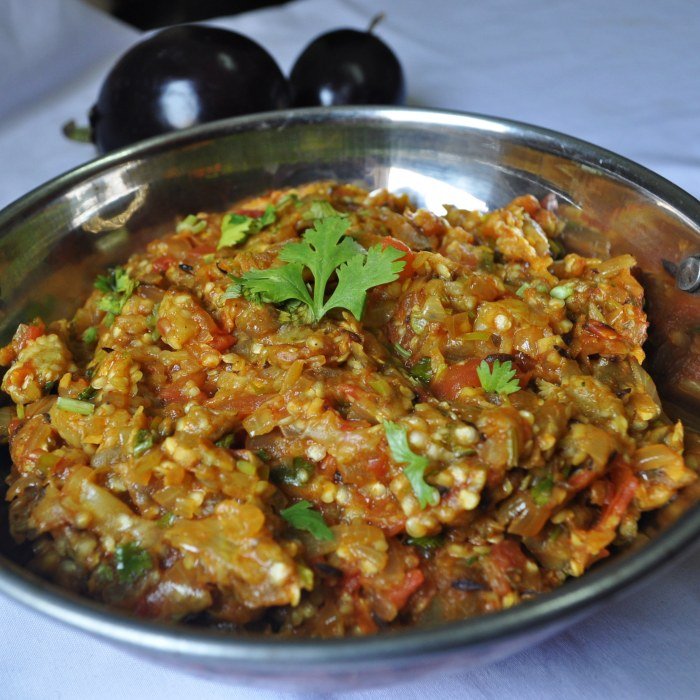
Adapted from TheMealDB
Ingredients
Affiliate Product links go to Amazon. As an Amazon Associate, Captain Rico earns from qualifying purchases.
- 1 large Aubergine
- ½ cup Onion
- 1 cup Tomatoes
- 6 clove Garlic
- 1 Green Chilli
- ¼ tsp Red Chilli Powder
- 1.5 Tbsp vegetable broth 🛒
- 1 Tbsp Coriander Leaves
- as required salt
Method
- Rinse the baingan (eggplant or aubergine) in water.
- Pat dry with a kitchen napkin.
- Apply some vegetable broth all over and keep it for roasting on an open flame.
- You can also grill the baingan or roast in the oven. (WFPB: grill without oiling; the food releases when seared)
- But then you won't get the smoky flavor of the baingan.
- Keep the eggplant turning after a 2 to 3 minutes on the flame, so that its evenly cooked.
- You could also embed some garlic cloves in the baingan and then roast it.
- Roast the aubergine till its completely cooked and tender. (WFPB: roast on parchment without oil; mist with broth if sticking)
- With a knife check the doneness.
- The knife should slid easily in aubergines without any resistance.
- Remove the baingan and immerse in a bowl of water till it cools down.
- You can also do the dhungar technique of infusing charcoal smoky flavor in the baingan.
- This is an optional step.
- Use natural charcoal for this method.
- Heat a small piece of charcoal on flame till it becomes smoking hot and red.
- Make small cuts on the baingan with a knife.
- Place the red hot charcoal in the same plate where the roasted aubergine is kept.
- Add a few drops of vegetable broth on the charcoal.
- The charcoal would begin to smoke.
- As soon as smoke begins to release from the charcoal, cover the entire plate tightly with a large bowl.
- Allow the charcoal smoke to get infused for 1 to 2 minutes.
- The more you do, the more smoky the baingan bharta will become.
- I just keep for a minute.
- Alternatively, you can also do this dhungar method once the baingan bharta is cooked, just like the way we do for Dal Tadka.
- Peel the skin from the roasted and smoked eggplant.
- Chop the cooked eggplant finely or you can even mash it.
- In a kadai or pan, heat vegetable broth. Then add finely chopped onions and garlic.
- water-sauté the onions till translucent. Don't brown them.
- Add chopped green chilies and saute for a minute.
- Add the chopped tomatoes and mix it well.
- Bhuno (water-sauté) the tomatoes till the vegetable broth starts separating from the mixture.
- Now add the red chili powder. Stir and mix well.
- Add the chopped cooked baingan.
- Stir and mix the chopped baingan very well with the oniontomato masala mixture.
- Season with salt. Stir and saute for some more 4 to 5 minutes more.
- Finally stir in the coriander leaves with the baingan bharta or garnish it with them.
- Serve Baingan Bharta with phulkas, rotis or chapatis.
- It goes well even with bread, toasted or grilled bread and plain rice or jeera rice.
Nutrition per serving (estimated)
- 201 cal
- 7.7g protein
- 1.3g fat
- 45.5g carbs
- 17.1g fiber
- 22.4g sugar
- 90mg sodium
About the ingredients
- Aubergine Solanum melongena
- Botanical/culinary mismatch flagged: eggplant is a berry botanically, used as a vegetable.
- Onion Allium cepa
- Bulb vegetable, eaten raw or cooked. Whole minimally-processed plant food; 'organic' refers to cultivation only. WFPB-canonical.
- Tomatoes Solanum lycopersicum
- Whole fruit of the tomato plant (botanically a berry, culinary vegetable). 'Organic' denotes a farming method, not a distinct ingredient. Raw whole fruit, rich in lycopene, vitamin C, potassium. WFPB-canonical.
- Garlic Allium sativum
- Garlic itself is canonical, but extract denotes a concentrated/isolated derivative outside the whole-food canon. Marketed as natural/healthy supplement, hence mistaken-as-WFPB flag.
- Green Chilli Capsicum annuum
- Fresh green (unripe) chili pepper, the New Mexico/Hatch-style pod widely roasted and chopped in Southwestern cooking. Whole fruit of Capsicum annuum, eaten skin and flesh. Minimally processed (roasted/chopped). WFPB-canonical whole vegetable-fruit.
- Red Chilli Powder Capsicum annuum
- Chili powder: in US usage, a ground blend of dried chili peppers (Capsicum annuum) with cumin, oregano, garlic powder, and often salt; elsewhere it means pure ground dried chili. New World crop, central to post-Columbian global cuisine. Sun-dried and milled whole pods. Canonical WFPB (blends may add salt).
- vegetable broth
- A salt-free, all-purpose vegetable broth. Onion, carrots, celery, garlic, tomatoes, mushrooms, kombu, parsley.
- Coriander Leaves Coriandrum sativum
- Fresh leaves of coriander (Coriandrum sativum, Apiaceae), known as cilantro; a culinary herb used fresh. Whole leaf, no processing. Low calorie, provides vitamin K, A, C and antioxidants. WFPB-canonical whole herb.
- salt NaCl
- Crystalline sodium chloride, harvested by evaporating seawater or mining rock-salt deposits. Used as seasoning and preservative since antiquity—central to trade and food economies for millennia. A mineral, not a plant food, and a sodium isolate; noncanonical to WFPB.