Roasted Eggplant With Tahini, Pine Nuts, and Lentils
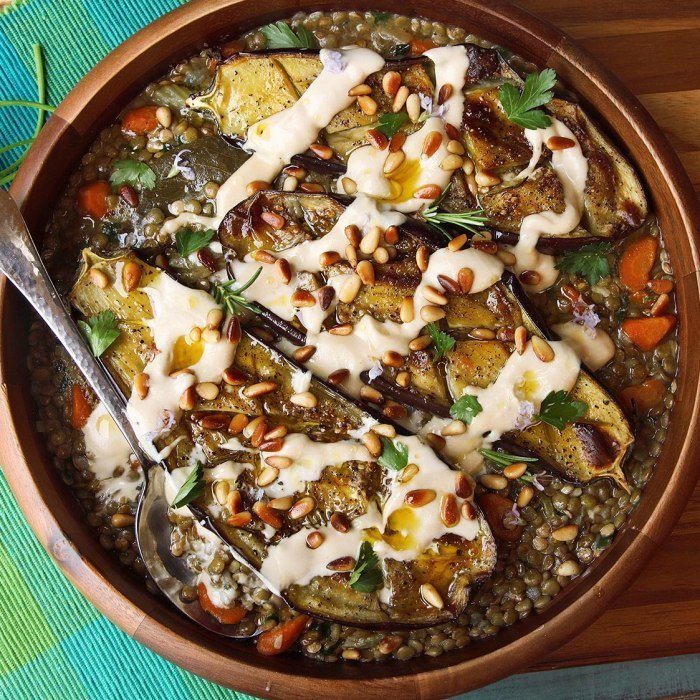
Adapted from TheMealDB
Ingredients
Affiliate Product links go to Amazon. As an Amazon Associate, Captain Rico earns from qualifying purchases.
- 2 Tbsp vegetable broth 🛒
- 2 small cut into chunks Carrots
- 2 small stalks Celery
- 1 medium finely diced Onion
- 6 medium cloves sliced Garlic
- 12 oz Brown Lentils
- 2 Bay Leaves
- 4 cup Water
- pinch Salt
- 2 tsp Apple Cider Vinegar
- pinch Pepper
- 2 large flax egg
- 4 sprig Rosemary
- ¼ cup Pine nuts
- 2 Tbsp Parsley
Method
- Prep: mix 1 Tbsp ground flax + 3 Tbsp water, rest 5 min.
- For the Lentils: Adjust oven rack to center position and preheat oven to 450°F to prepare for roasting eggplant.
- Meanwhile, heat 2 tablespoons vegetable broth in a medium saucepan over medium heat until shimmering.
- Add carrots, celery, and onion and cook, stirring, until softened but not browned, about 4 minutes.
- Add garlic and cook, stirring, until fragrant, about 30 seconds.
- Add lentils, bay leaves, stock or water, and a pinch of salt.
- Bring to a simmer, cover with the lid partially ajar, and cook until lentils are tender, about 30 minutes. (Top up with water if lentils are at any point not fully submerged.) Remove lid, stir in vinegar, and reduce until lentils are moist but not soupy.
- Season to taste with salt and pepper, cover, and keep warm until ready to serve.
- For the Eggplant: While lentils cook, cut each eggplant in half.
- Score flesh with the tip of a paring knife in a cross-hatch pattern at 1-inch intervals.
- Transfer to a foil-lined rimmed baking sheet, cut side up, and brush each eggplant half with 1 tablespoon vegetable broth, letting each brushstroke be fully absorbed before brushing with more.
- Season with salt and pepper.
- Place a rosemary sprig on top of each one.
- Transfer to oven and roast until completely tender and well charred, 25 to 35 minutes.
- Remove from oven and discard rosemary.
- To Serve: Heat 2 tablespoons vegetable broth and pine nuts in a medium skillet set over medium heat.
- Cook, tossing nuts frequently, until golden brown and aromatic, about 4 minutes.
- Transfer to a bowl to halt cooking.
- Stir half of parsley and rosemary into lentils and transfer to a serving platter.
- Arrange eggplant halves on top.
- Spread a few tablespoons of tahini sauce over each eggplant half and sprinkle with pine nuts.
- Sprinkle with remaining parsley and rosemary, drizzle with additional vegetable broth, and serve.
Nutrition per serving (estimated)
- 418 cal
- 24.2g protein
- 8.7g fat
- 64.2g carbs
- 12.4g fiber
- 5g sugar
- 61mg sodium
About the ingredients
- vegetable broth
- A salt-free, all-purpose vegetable broth. Onion, carrots, celery, garlic, tomatoes, mushrooms, kombu, parsley.
- Carrots Daucus carota
- Whole taproot, eaten raw or cooked. Orange domesticated form is the familiar one; heirloom landraces range purple to white.
- Celery Apium graveolens
- Crisp, fibrous leaf stalks (petioles) of Apium graveolens, eaten raw or cooked. Very low caloric density, high water and fiber; provides vitamin K, folate, potassium. Whole, intact vegetable, fully canonical to WFPB.
- Onion Allium cepa
- Bulb vegetable, eaten raw or cooked. Whole minimally-processed plant food; 'organic' refers to cultivation only. WFPB-canonical.
- Garlic Allium sativum
- Garlic itself is canonical, but extract denotes a concentrated/isolated derivative outside the whole-food canon. Marketed as natural/healthy supplement, hence mistaken-as-WFPB flag.
- Brown Lentils Lens culinaris
- Common whole brown lentils — small dried legume seeds that cook quickly without soaking, holding shape for stews and dals. High in protein, fiber, folate, and iron. Whole legume — WFPB canonical.
- Bay Leaves Laurus nobilis
- Bay leaf: aromatic leaf of the laurel tree Laurus nobilis, native to the Mediterranean and prized since antiquity (Greek/Roman symbolism). Used whole, dried or fresh, to infuse dishes then removed. Contains essential oils (eucalyptol). A whole dried herb/leaf. Canonical WFPB.
- Water
- Plain potable water (H2O). Universal solvent and culinary base, no calories or nutrients beyond trace minerals. Not derived from any organism; an unprocessed essential. WFPB canonical.
- Salt NaCl
- Crystalline sodium chloride, harvested by evaporating seawater or mining rock-salt deposits. Used as seasoning and preservative since antiquity—central to trade and food economies for millennia. A mineral, not a plant food, and a sodium isolate; noncanonical to WFPB.
- Apple Cider Vinegar Malus domestica
- Vinegar from apple juice double-fermented: sugars to alcohol, then alcohol to acetic acid by Acetobacter. Raw/unfiltered versions retain the 'mother.' A whole-fruit-derived acid used for brightness; no added oil/sugar. Canonical traditional ferment.
- Pepper Piper nigrum
- Dried unripe fruit (peppercorns) of the pepper vine, used whole or ground. A whole dried spice with nothing added or extracted. Canonical WFPB aromatic.
- flax egg
- A whole-food plant-based egg replacer. One flax egg = one egg in baking.
- Rosemary Salvia rosmarinus
- Fresh or dried rosemary leaf; both whole-food. Note name ambiguity vs rosemary extract/oil, but bare name = the herb.
- Pine nuts Pinus pinea
- Called a nut culinarily but botanically a gymnosperm seed; multiple Pinus species supply commercial pine nuts (pinea, koraiensis, gerardiana).
- Parsley Petroselinum crispum
- Fresh leafy herb in the carrot family; flat-leaf (Italian) and curly types. Eaten raw or added late as garnish/aromatic. Whole leaf and stem, no processing. Rich in vitamin K, C, A, folate. Whole plant — fully WFPB canonical.