Fasoliyyeh Bi Z-Zayt (Syrian Green Beans with Olive Oil)
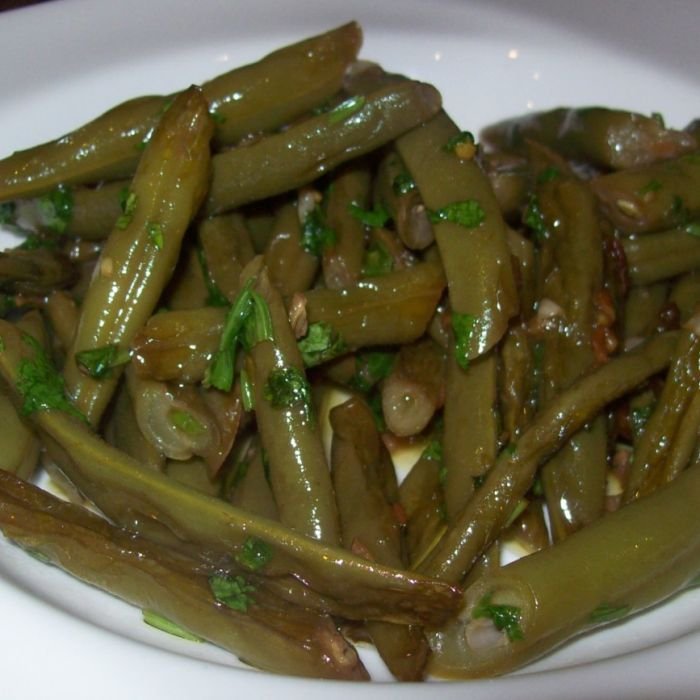
Adapted from TheMealDB
Ingredients
Affiliate Product links go to Amazon. As an Amazon Associate, Captain Rico earns from qualifying purchases.
- 16 oz Green Beans
- ¼ cup vegetable broth 🛒
- dash Salt
- 1 clove Garlic
- ¼ cup Cilantro
Method
- Place the green beans into a large pot, and drizzle with vegetable broth.
- Season with salt to taste, and put the lid on the pot.
- Cook over medium-high heat, stirring occasionally, until beans are cooked to your desired doneness.
- Syrians like it cooked until the green beans are turning brownish in color.
- The idea is not to water-sauté them, but to let them steam in the moisture released by the ice crystals.
- Add cilantro and garlic to the beans, and continue to cook just until the cilantro has started to wilt.
- Eat as a main course by scooping up with warm pita bread or serve as a side dish.
Nutrition per serving (estimated)
- 89 cal
- 4.1g protein
- 0.7g fat
- 16.6g carbs
- 4.9g fiber
- 0.4g sugar
- 90mg sodium
About the ingredients
- Green Beans
- Vegetable is a generic culinary category for edible plant parts—leaves, stems, roots, tubers, bulbs, flowers and some botanical fruits—eaten savory. As whole plant foods they are canonical and nutrient-dense (fiber, vitamins, minerals). Derived forms differ: vegetable juice (fiber removed) and vegetable oil (refined fat) are noncanonical.
- vegetable broth
- A salt-free, all-purpose vegetable broth. Onion, carrots, celery, garlic, tomatoes, mushrooms, kombu, parsley.
- Salt NaCl
- Crystalline sodium chloride, harvested by evaporating seawater or mining rock-salt deposits. Used as seasoning and preservative since antiquity—central to trade and food economies for millennia. A mineral, not a plant food, and a sodium isolate; noncanonical to WFPB.
- Garlic Allium sativum
- Garlic itself is canonical, but extract denotes a concentrated/isolated derivative outside the whole-food canon. Marketed as natural/healthy supplement, hence mistaken-as-WFPB flag.
- Cilantro Coriandrum sativum
- Fresh leaves of coriander (Coriandrum sativum, Apiaceae), known as cilantro; a culinary herb used fresh. Whole leaf, no processing. Low calorie, provides vitamin K, A, C and antioxidants. WFPB-canonical whole herb.