CAPTAIN RICO · FIELD NOTES
What Earned Its Place—and What I’m Still Evaluating
Repeat orders, successful repairs and unfinished evaluations are different kinds of evidence. Here is how I separate them.

Affiliate disclosure: As an Amazon Associate I earn from qualifying purchases. Product links in this article are affiliate links.
An affiliate site shouldn’t make every purchase sound like a triumph. My own orders contain several different kinds of evidence: food I kept ordering, parts that fit a specific repair, equipment that became a working project, and something I’m still evaluating.
Those categories deserve different language. “I bought it” is not the same as “I tested it.” “It fit my door” is not the same as “it fits yours.” And “I haven’t decided yet” is a useful answer.
Repeat purchases are a starting point
My snack bars, nuts, edamame and breakfast staples recur through the 2026 orders. That supports a story about routine. It doesn’t support declaring every item the healthiest, cheapest or best on the market.
For the actual counts and product choices, see what I keep buying. The counts exclude cancelled orders and refer to specific listings. They aren’t product ratings, and they don’t tell us why somebody else should buy the same thing.
A successful repair has a narrower, stronger claim
The garage-door opener belt and patio-door exterior handles each fit our equipment perfectly. Those are useful firsthand outcomes. They let me describe the part I used and the problem it addressed without pretending that compatibility is universal.
That distinction is especially important with replacement hardware. Start with the model and measurements of the thing you already own. My experience can help you ask better questions; it cannot replace checking your part.
“Worked, but…” belongs in a review
The headlight restoration kit worked, but our preparation could have been better: we should have sanded more. I would rather include that qualification than turn the experience into an uncomplicated before-and-after success story.
It is also not fair to call that a product failure. The lesson concerns how we used it. Follow the manufacturer’s preparation steps, assess the surface, and keep any claim about the result within what you can actually observe.
A working project needs evidence beyond the purchase
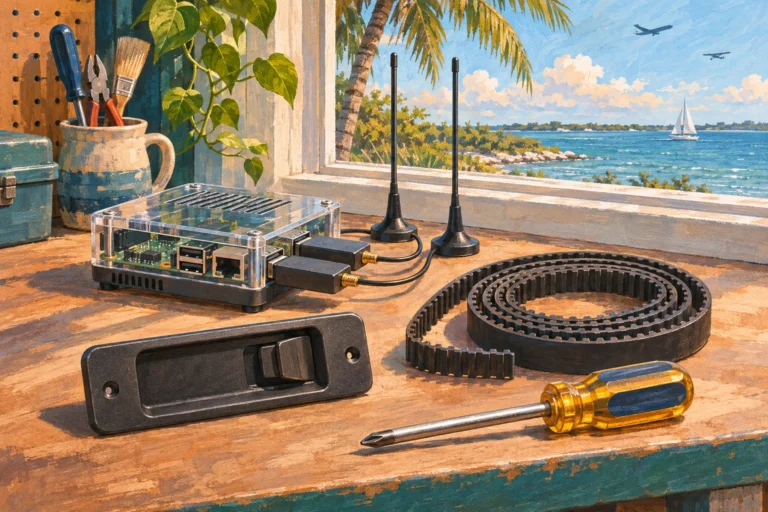
The Raspberry Pi and SDR setup is already doing a job: receiving AIS and ADS-B. The project story separates my experience from a read-only check of the running setup. That is a more meaningful basis for writing about it than the fact that a kit arrived in a box.
The Reolink camera’s appeal was its suitability for an AI automation project. A useful account of that work should describe the integration actually achieved, with its limits, rather than suggesting that every desired feature arrives fully configured.
The open question: the access point
The TP-Link EAP610 is still being evaluated. A proper verdict needs a comparison in the intended location: signal and reliability, transfer performance, latency under comparable conditions, and whether the devices that matter are actually using it.
A single connected device or a single speed result would not settle all of that. Until the evidence is there, “under evaluation” is the honest label. I don’t need a negative verdict to justify waiting.
What I want these stories to do
The goal is to leave you better equipped to decide. Sometimes that means a specific ingredient list. Sometimes it means a compatibility check. Sometimes it means learning that preparation mattered more than I expected.
I earn from qualifying purchases made through affiliate links, but the link should follow the experience—not create a verdict that wasn’t there. On this site, a repeat buy, a successful repair and an unresolved evaluation can all have a place, as long as I tell you which one you’re reading.