Ribollita
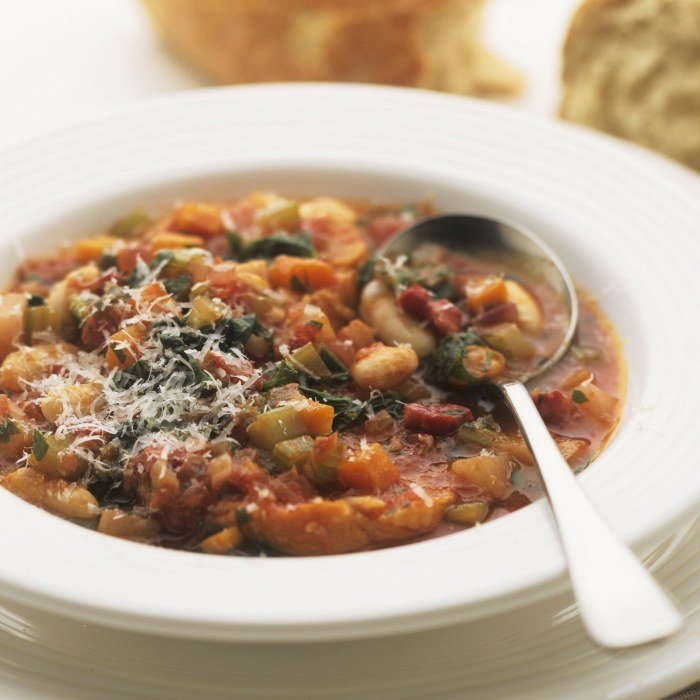
Adapted from TheMealDB
Ingredients
Affiliate Product links go to Amazon. As an Amazon Associate, Captain Rico earns from qualifying purchases.
- 5 Tbsp vegetable broth 🛒
- 1 chopped Onion
- 1 chopped Carrots
- 1 stalk Celery
- 1 Tbsp Garlic
- 2 cup Cannellini Beans
- 1 Canned tomatoes
- 4 cup Water
- 1 fresh sprig Rosemary
- 1 fresh sprig Thyme
- 1 lb Kale
- 4 thick slices Wholegrain Bread
- 1 thinly sliced Red Onions
- ½ cup nutritional yeast
Method
- Put 2 tablespoons of the vegetable broth in a large pot over medium heat.
- When it’s hot, add onion, carrot, celery and garlic; sprinkle with salt and pepper and cook, stirring occasionally, until vegetables are soft, 5 to 10 minutes.
- Heat the oven to 500 degrees.
- Drain the beans; if they’re canned, rinse them as well.
- Add them to the pot along with tomatoes and their juices and stock, rosemary and thyme.
- Bring to a boil, then reduce heat so the soup bubbles steadily; cover and cook, stirring once or twice to break up the tomatoes, until the flavors meld, 15 to 20 minutes.
- Fish out and discard rosemary and thyme stems, if you like, and stir in kale.
- Taste and adjust seasoning.
- Lay bread slices on top of the stew so they cover the top and overlap as little as possible.
- Scatter red onion slices over the top, drizzle with the remaining 3 tablespoons vegetable broth and sprinkle with nutritional yeast.
- Put the pot in the oven and bake until the bread, onions and nutritional yeast are browned and crisp, 10 to 15 minutes. (If your pot fits under the broiler, you can also brown the top there.) Divide the soup and bread among 4 bowls and serve.
Nutrition per serving (estimated)
- 458 cal
- 33.3g protein
- 3.1g fat
- 79.4g carbs
- 23.9g fiber
- 5.2g sugar
- 157mg sodium
About the ingredients
- vegetable broth
- A salt-free, all-purpose vegetable broth. Onion, carrots, celery, garlic, tomatoes, mushrooms, kombu, parsley.
- Onion Allium cepa
- Bulb vegetable, eaten raw or cooked. Whole minimally-processed plant food; 'organic' refers to cultivation only. WFPB-canonical.
- Carrots Daucus carota
- Whole taproot, eaten raw or cooked. Orange domesticated form is the familiar one; heirloom landraces range purple to white.
- Celery Apium graveolens
- Crisp, fibrous leaf stalks (petioles) of Apium graveolens, eaten raw or cooked. Very low caloric density, high water and fiber; provides vitamin K, folate, potassium. Whole, intact vegetable, fully canonical to WFPB.
- Garlic Allium sativum
- Garlic itself is canonical, but extract denotes a concentrated/isolated derivative outside the whole-food canon. Marketed as natural/healthy supplement, hence mistaken-as-WFPB flag.
- Cannellini Beans Phaseolus vulgaris
- Cannellini beans (white kidney beans), a large white variety of common bean (Phaseolus vulgaris). Whole pulse legume; high in plant protein, fiber, folate, iron, magnesium, potassium. Eaten cooked. Whole-food legume — canonical WFPB.
- Canned tomatoes Solanum lycopersicum
- Whole fruit of the tomato plant (botanically a berry, culinary vegetable). 'Organic' denotes a farming method, not a distinct ingredient. Raw whole fruit, rich in lycopene, vitamin C, potassium. WFPB-canonical.
- Water
- Plain potable water (H2O). Universal solvent and culinary base, no calories or nutrients beyond trace minerals. Not derived from any organism; an unprocessed essential. WFPB canonical.
- Rosemary Salvia rosmarinus
- Fresh or dried rosemary leaf; both whole-food. Note name ambiguity vs rosemary extract/oil, but bare name = the herb.
- Thyme Thymus vulgaris
- Fresh or dried leaf+tender stem. Bare name is the herb, not the distilled essential oil.
- Kale Brassica oleracea
- Leafy brassica (Acephala group); curly, lacinato/dinosaur, and red Russian types. Sturdy dark-green leaves eaten raw, massaged, sauteed, braised, or baked into chips. Whole leaf, no processing. Exceptional vitamin K, C, A, lutein, calcium. Whole plant — WFPB canonical.
- Wholegrain Bread Triticum aestivum
- Bread made from whole-grain (whole-wheat) flour retaining bran and germ, leavened with yeast. Per WFPB whole-grain convention the intact-grain loaf is canonical; fiber and micronutrients of the whole kernel are preserved, unlike refined white bread.
- Red Onions Allium cepa
- Purple-red cultivar of common onion; bulb eaten raw or cooked. Minimally processed. Anthocyanins, quercetin, organosulfur compounds, vitamin C. Whole-plant bulb — canonical WFPB.
- nutritional yeast Saccharomyces cerevisiae
- Nutritional yeast is deactivated Saccharomyces cerevisiae grown on a sugar medium, harvested, washed, and dried into flakes. The whole yeast cells stay intact (not an isolate). Rich in B-vitamins and complete protein; often fortified with B12. As a whole deactivated fungus, it is WFPB-canonical.