Roast fennel and aubergine paella
Smoky Spanish-style paella with roasted fennel, aubergine, peppers, and courgette folded into saffron-and-paprika rice. Finished with sweet peas, lemon, and parsley for a bright, golden one-pan meal that feeds a crowd.
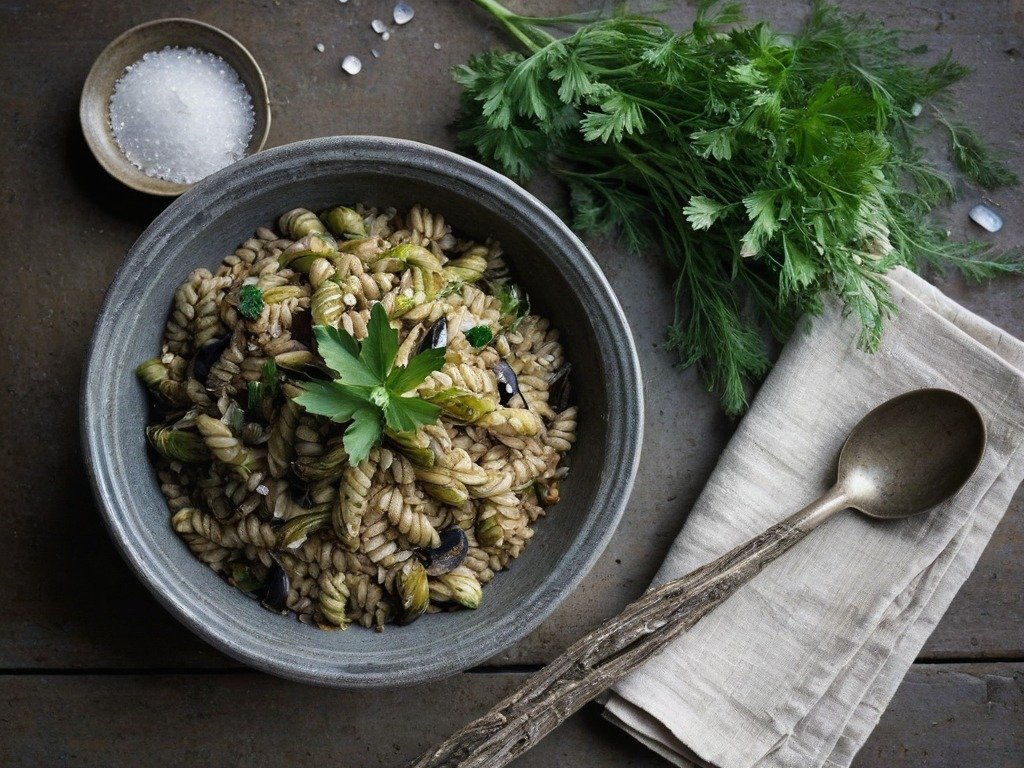
Adapted from TheMealDB
Ingredients
Affiliate Product links go to Amazon. As an Amazon Associate, Captain Rico earns from qualifying purchases.
- 6 small Baby Aubergine
- 4 small Fennel
- 1 thinly sliced Red Pepper
- 1 medium Courgettes
- 1 finely chopped Onion
- 10½ oz Paella Rice
- 1 tsp Paprika
- pinch Saffron
- 6¾ fl oz White Wine
- 3 cups Vegetable Stock 🛒
- 3½ oz Frozen Peas
- 1 chopped Lemon
- handful Parsley
- pinch Salt
- pinch Black Pepper
Method
- Put the fennel, aubergine, pepper and courgette in a roasting tray.
- Add a glug of olive oil, season with salt and pepper and toss around to coat the veggies in the oil.
- Roast in the oven for 20 minutes, turning a couple of times until the veg are pretty much cooked through and turning golden.
- Meanwhile, heat a paella pan or large frying pan over a low– medium heat and add a glug of olive oil.
- Sauté the onion for 8–10 minutes until softened.
- Increase the heat to medium and stir in the rice, paprika and saffron.
- Cook for around 1 minute to start toasting the rice, then add the white wine.
- Reduce by about half before stirring in two-thirds of the stock.
- Reduce to a simmer and cook for 10 minutes without a lid, stirring a couple of times.
- Stir in the peas, add some seasoning, then gently mix in the roasted veg.
- Pour over the remaining stock, arrange the lemon wedges on top and cover with a lid or some aluminium foil.
- Cook for a further 10 minutes.
- To ensure you get the classic layer of toasted rice at the bottom of the pan, increase the heat to high until you hear a slight crackle.
- Remove from the heat and sit for 5 minutes before sprinkling over the parsley and serving.
Nutrition per serving (estimated)
- 118 cal
- 3.3g protein
- 0.6g fat
- 24.6g carbs
- 5.3g fiber
- 6.1g sugar
- 93mg sodium
About the ingredients
- Baby Aubergine Solanum melongena
- Botanical/culinary mismatch flagged: eggplant is a berry botanically, used as a vegetable.
- Fennel Foeniculum vulgare
- Fennel, Foeniculum vulgare, an ancient Mediterranean Apiaceae used by Greeks and Romans. Both the bulb (swollen leaf base) and seeds are eaten; aromatic anise flavor. Eaten raw or cooked. Provides vitamin C, potassium, fiber. Whole-food vegetable/herb: canonical.
- Red Pepper Piper nigrum
- Dried unripe fruit (peppercorns) of the pepper vine, used whole or ground. A whole dried spice with nothing added or extracted. Canonical WFPB aromatic.
- Courgettes Cucurbita pepo
- Summer squash harvested immature; eaten whole (skin, flesh, seeds) raw or cooked. Botanically a fruit (berry/pepo), culinary vegetable. No processing. Low calorie, high water, vitamin C and potassium. WFPB canonical.
- Onion Allium cepa
- Bulb vegetable, eaten raw or cooked. Whole minimally-processed plant food; 'organic' refers to cultivation only. WFPB-canonical.
- Paella Rice Oryza sativa
- Short-grain Spanish rice variety (typically Bomba or Calasparra) prized for absorbing broth without turning mushy. A whole cereal grain by name; the historian dates Valencian paella rice to Moorish irrigation agriculture in eastern Spain. Canonical as a grain.
- Paprika Capsicum annuum
- Ground spice made from dried, milled red peppers (Capsicum annuum), ranging sweet to hot/smoked. Whole-fruit powder, no additions. Source of vitamin A (carotenoids), vitamin E, capsaicin. Minimally processed whole-food spice, WFPB canonical.
- Saffron Crocus sativus
- Saffron is the dried red stigmas of the autumn crocus (Crocus sativus), hand-harvested—the world's costliest spice. Cultivated since Bronze Age Crete and Persia, prized for color (crocin), aroma (safranal) and flavor. A whole, sun-dried plant part used in tiny amounts; fully canonical under WFPB.
- White Wine Vitis vinifera
- Fermented, often distilled-clarified juice of wine grapes (Vitis vinifera). Alcoholic beverage; alcohol is noncanonical to WFPB. The 'for sautéing' is instruction text; the resolvable ingredient is white wine.
- Vegetable Stock
- A salt-free, all-purpose vegetable broth. Onion, carrots, celery, garlic, tomatoes, mushrooms, kombu, parsley.
- Frozen Peas
- Vegetable is a generic culinary category for edible plant parts—leaves, stems, roots, tubers, bulbs, flowers and some botanical fruits—eaten savory. As whole plant foods they are canonical and nutrient-dense (fiber, vitamins, minerals). Derived forms differ: vegetable juice (fiber removed) and vegetable oil (refined fat) are noncanonical.
- Lemon Citrus limon
- Lemon is the acidic tree fruit (hesperidium) of Citrus limon, a Rutaceae shrub of likely Northeast Indian origin. Eaten as fresh fruit, juice, and zest. Rich in vitamin C, citric acid, flavonoids. Whole fruit and its fresh juice are canonical WFPB foods.
- Parsley Petroselinum crispum
- Fresh leafy herb in the carrot family; flat-leaf (Italian) and curly types. Eaten raw or added late as garnish/aromatic. Whole leaf and stem, no processing. Rich in vitamin K, C, A, folate. Whole plant — fully WFPB canonical.
- Salt NaCl
- Crystalline sodium chloride, harvested by evaporating seawater or mining rock-salt deposits. Used as seasoning and preservative since antiquity—central to trade and food economies for millennia. A mineral, not a plant food, and a sodium isolate; noncanonical to WFPB.